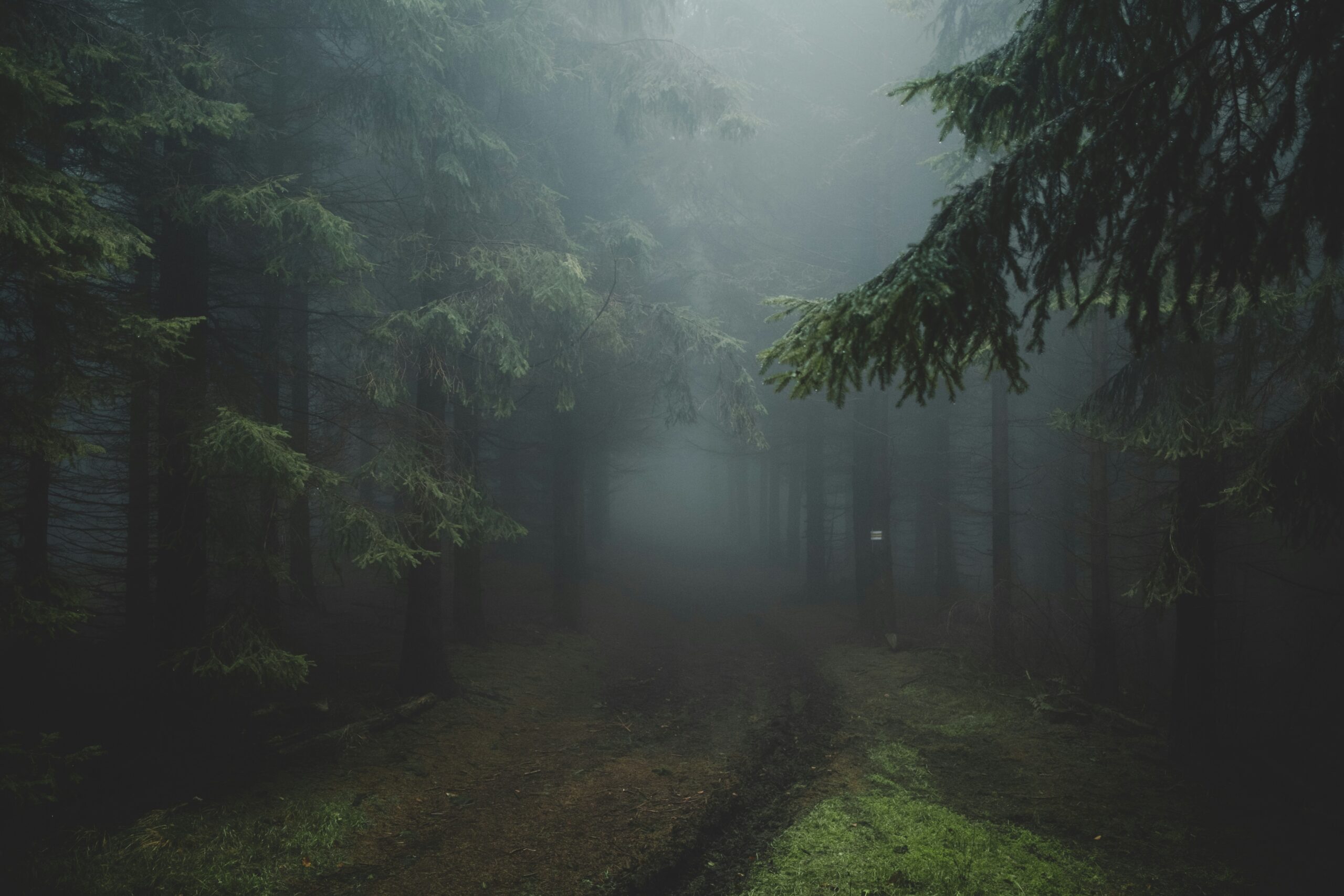
I was walking through a heavily wooded forest, many years ago, when I first understood it.
There are some understandings that you feel inside, and this was one of those. It’s the way that you understand cold water or a sudden drop in altitude.
I was walking through a forest when I first felt it. I was about twenty steps from the lightly coloured gravel path when the quality of the silence around changed. A slight change in the way the wind surrounded me, although not much louder, but in a way that made my skin respond before my mind caught up.
I knew that something was watching, in a way animals’ sense and know, not through reasoning, but something older than reasoning. The branches in the trees were still as the wind moved through them in a way which felt less like the weather and more like breath. A low whistle followed, directionless, coming from no particular direction. This made me turn around and walk back to the path, taking some quick steps short of running.
I have thought about that moment many times since. Not because it frightened me, though it did, but because what it made me remember: virtually every culture in recorded human history has believed in spirits, supernatural beings of some sort.
I looked into this and found the Japanese call them kami. In essence, presences inhabiting natural objects, rivers, trees and the wind itself. The ancients kept lares in their homes, which they regarded as household spirits that were attached to specific places, not people. The Inuit of the circumpolar north held that every living thing possessed an inua, a spirit that persisted after the physical form was gone. The Yoruba of West Africa maintained a living relationship with orisha, divine forces expressing themselves through the natural world. The ancient Celts understood the forest as inhabited, not metaphorically but literally. Druidic practice was built on the conviction that certain places were thin: that what separated the visible world from another was, in those locations, barely a membrane.
What’s interesting is that these civilisations had no contact with each other, having no shared language or common history. They arrived at the same conviction independently, across thousands of years and every inhabitable continent on earth.
It is commonly thought that human beings are pattern-recognition beings who mistake coincidence for causation, such as movement in the trees for watching eyes or the wind for breath. Essentially, saying that we invented spirits to explain what we could not otherwise account for.
But this has always seemed insufficient to me. It tells us what the belief is doing without addressing why the experience itself is so consistent. Why does every culture describe the same sensation? The feeling of presence without the accompanying physical source. The way certain places seem to breathe. The sense, in a forest or at a threshold or in the last moments before sleep, that something is there, something that predates you, that will persist after you, that is neither threatening nor safe but simply present and aware.
Robin Wall Kimmerer, an anthropologist, writes about Potawatomi as a language that does not cast the living world into the silence of objects. In it, animals, plants, water, and wind are spoken of as beings, mere presences, lives that meet us rather than things that surround us. Not because a river is mistaken for a person, but because the language remembers a truth English has long since dimmed: that the world is alive in ways we no longer know how to name. The real question, then, is not whether the river has a spirit, but whether we have forgotten how to feel the spirit that has always moved within it.
I created Nytheria, a spirit realm that is one thousand light-years from Earth, not as pure invention, but as a way of naming something I had already half-sensed. Its beings are not ghosts in the Western sense, but presences: enduring, aware, and shaped by laws older than the ones that govern ordinary life. They are the same kinds of presences humanity has always sensed in the wind, in the forest, and in the moments before sleep.
My novels begin where that forest moment began for me. With the certainty that something is watching, and the quiet, urgent question of what it wants.
If that question is already yours, the Nytherian Universe begins here: Nytherian Universe. If you’d rather linger at the threshold a little longer, join the Attuned and receive the first dispatch of Whispers from Nytheria.