
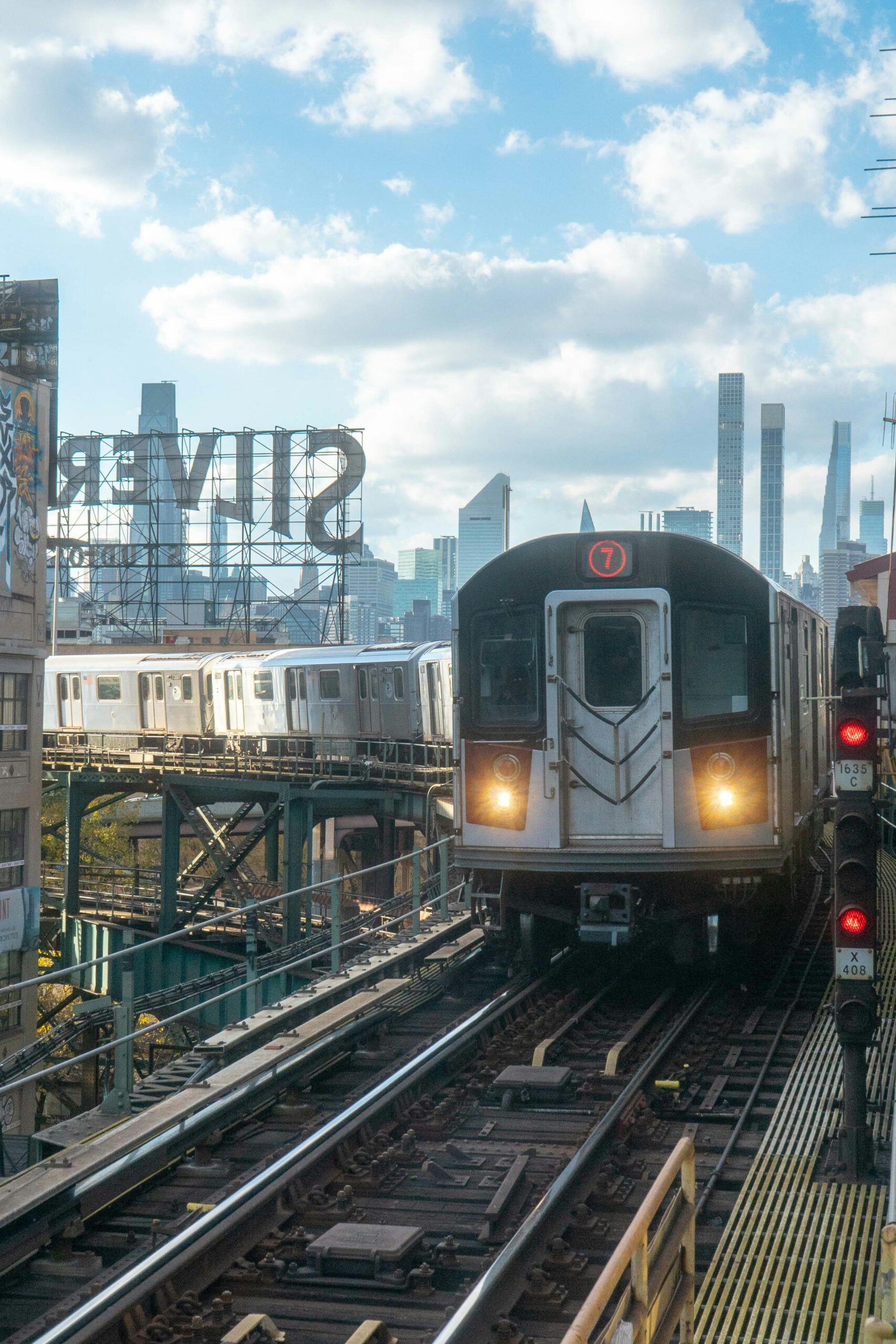
The 7 train. That is what they call it. The line that runs from Times Square east through the boroughs, past towers and taxi ranks and the compressed, various life of Queens, all the way to the stadium where the US Open fills the air with something close to electricity for two weeks every summer.
I descended into Grand Central on a morning already set on being relentless. The platform heat felt physical, pressing against my chest like a hand, while the tunnel exhaled short, warm bursts. Around me, seasoned commuters moved with practiced efficiency: phones out, eyes forward, each making small, automatic adjustments. I was not practiced. Standing well behind the yellow line, I stared into the tunnel until the train arrived with controlled violence, with a rush of displaced air, the long shriek of brakes, and opened its doors. I pressed in with everyone else.
What I found inside that carriage was the world at large.
This is not a metaphor. Literally people from all parts of the world, packed into one moving space beneath the streets of New York.
To my left: a woman with three shopping bags wedged between her legs, watching something on her phone with the focused pleasure of someone who has earned this exact moment of stillness. Across from her: two men were deep in an argument conducted entirely in a language I could not name, their hands doing most of the real work of it, their faces cycling through frustration and laughter and back again with a speed that suggested this argument was also, somewhere in its interior, a form of love. A teenager sealed inside his headphones so completely that the music leaked outward and became part of the carriage’s general sound.
A child, small enough that the overhead rail was level with her forehead, was pressing her face against the window glass as though she could see through the tunnel darkness if she tried hard enough. As though she suspected something was out there and was not prepared to stop looking simply because the adults around her had.
One could see that every face was a closed country. Every expression was the surface the day had imposed rather than the one that lived underneath it.
Walt Whitman walked these streets a century and a half before the subway was built and wrote about exactly this quality in New York’s faces, the way each ordinary person carries a cosmos, the way being surrounded by strangers is not an absence of connection but its most honest form. I had read those words many times. Riding the 7 train to Flushing, I understood them for the first time in my body rather than my head. Every person in that carriage was the visible edge of something vast and mostly hidden. Life, in my experience, does its most significant work below the surface.
The stations came at intervals. 5th Avenue. Vernon Boulevard. 33rd Street. Queensboro Plaza. Each one the same small ritual: the train slows, the pressure changes in the ears, the doors slide open with a sound like a breath released after too long held. You’ll see people leave and others enter. Then the doors close again, on their own schedule, entirely indifferent to whether you are ready, and the train pulls forward and the platform disappears and the underground dark returns.
I began watching the doors very carefully.
The decision, that is to stay or to go, is made inside the seconds the doors are open, no more. The platform is right there. You could step off. You could change everything about where you are going simply by lifting one foot and placing it differently. The option is real, and it costs nothing, and it is available for exactly as long as the doors allow, which is not very long at all.
Life does this. The pivots, the moments that divide one version of everything from another, do not arrive with adequate notice. They arrive with the notice the subway doors give you: a change of pressure, a brief opening, the sound of something releasing. You move, or you do not. Then the doors close regardless, and the train moves on, and you are still on it heading wherever it was already taking you.
I thought, in the rocking dark between stations, about every platform I had stayed on and everyone I had left. About the decisions that felt like decisions and the ones that only revealed themselves as such years later, from the other end.
The train surfaced into Queens somewhere around Queensboro Plaza, and the tunnel gave way to elevated track and open sky and the city sprawling below in every direction. By the time we reached Mets-Willets Point, the stadium was already audible, not visible yet, just present, the way a Nytherian presence is often felt before it is perceived.
The carriage emptied onto the platform, and the faces from the journey dispersed into the larger crowd: the woman with the shopping bags still watching her phone; the two men, their argument apparently resolved or at least suspended; the child, finally separated from the window, blinking in the outdoor light. Each of them carrying their invisible cargo of pain and hope and ordinary daily courage toward the same point, for an afternoon.
I had walked the length of this city on foot before and felt something arrive in my body from a direction I could not account for. I have written before about what the great players access when they cross the threshold inside a match, the zone that no coach has ever been able to teach. New York contains all of it simultaneously: the city that does things to a person on foot, and the stadium where the same crossing happens under floodlights in front of twenty thousand people.
The 7 train as a microcosm of the world: Inside the carriage, the world comes together: people from all parts of the world packed into one moving space beneath the streets of New York.
What I could not stop thinking about, riding back to Manhattan as the evening light went bronze over Queens, was the weight of what that carriage had contained that morning.
Every life was a complete universe of experience, pressed briefly against every other universe in the underground dark. The child looking for something in the tunnel glass. The argument that was also a form of love. All of it real, all of it invisible to everyone else in the carriage, all of it being carried somewhere at speed with no more notice of its own significance than the train gave the platforms it passed through.
Nytheria is a realm built on the conviction that none of it disappears. The grief behind the woman’s eyes as well as the decision unmade at 33rd Street. The exact weight of the child’s attention pressed against dark glass. These are not small things that evaporate when the moment passes. They persist, as frequency, as presence, as the kind of accumulated human charge that Nytherian spirits move through and are drawn toward.
A subway carriage is one of the most spiritually charged environments on earth. Not because anything extraordinary happens inside it. But because of the sheer density of ordinary human experience it contains, compressed, moving fast, separated by the precise distance that makes intimacy impossible and makes observation, if you are paying any attention at all, almost unbearable.
The 7 train runs thirty minutes from Times Square to Flushing. I have been thinking about it for weeks.
Leave a Reply